Common Cybersecurity Threats and How to Avoid Them
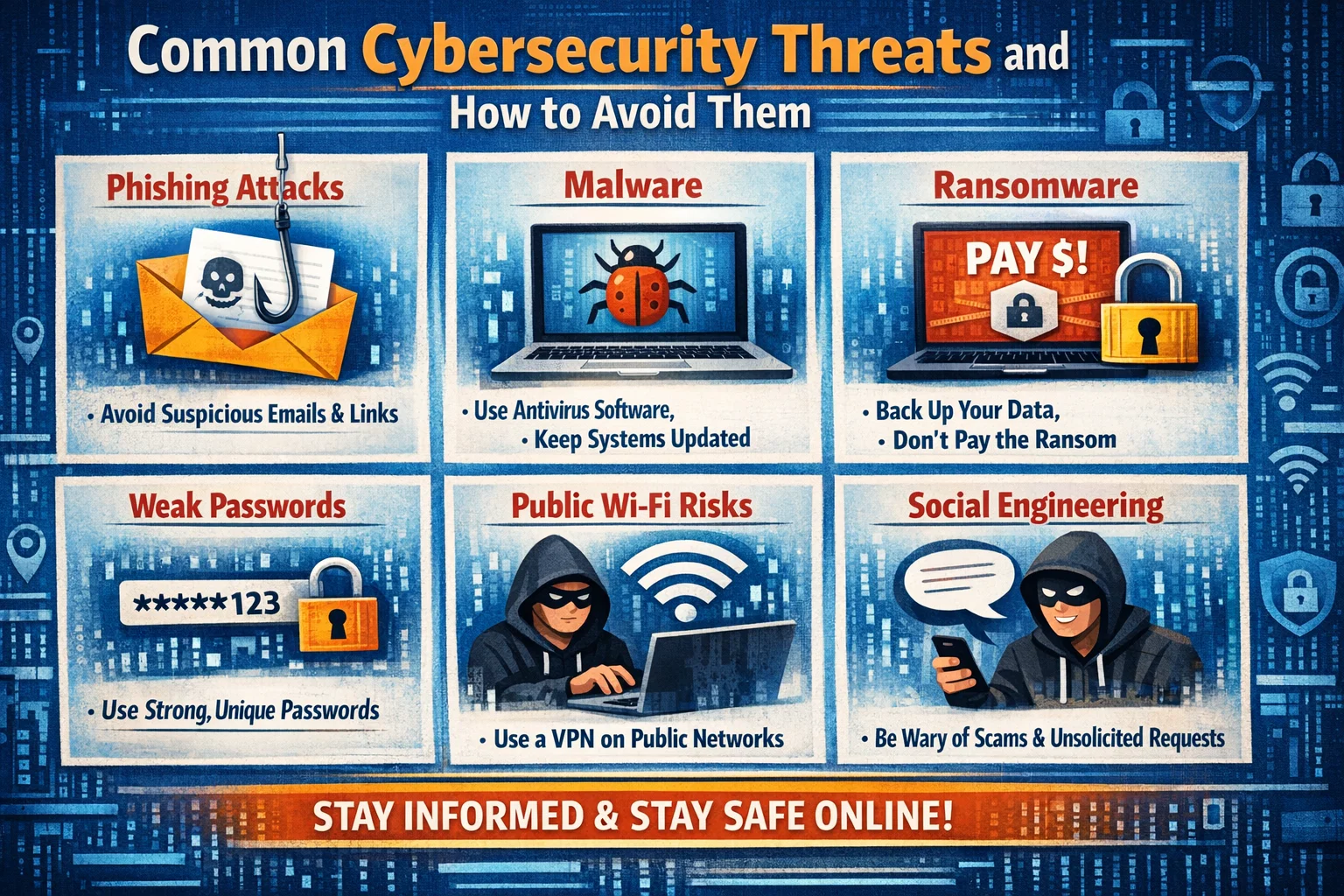
Common Cybersecurity Threats and How to Avoid Them
Cybersecurity threats have become one of the most serious risks facing individuals, businesses, and governments worldwide. As digital transformation accelerates across industries such as finance, healthcare, e-commerce, cloud computing, and remote work, cybercriminals are exploiting vulnerabilities with increasing sophistication.
From phishing scams and ransomware attacks to advanced persistent threats and zero-day exploits, cybersecurity threats can result in financial losses, identity theft, reputational damage, regulatory penalties, and long-term operational disruption. Understanding these threats—and knowing how to prevent them—is critical in today’s digital economy.
What Are Cybersecurity Threats?
Cybersecurity threats are malicious actions designed to damage, steal, disrupt, or gain unauthorized access to digital systems, networks, and data. These threats can target individuals, small businesses, large enterprises, and critical infrastructure.
Cyber threats continue to evolve due to advancements in automation, artificial intelligence, and global connectivity, making proactive cybersecurity measures essential.
Why Cybersecurity Threats Are Increasing Rapidly
- Widespread adoption of cloud services
- Remote and hybrid work environments
- Increased online financial transactions
- Growing use of IoT and smart devices
- Data-driven business models
Most Common Cybersecurity Threats in 2026
1. Phishing Attacks
Phishing is one of the most common and effective cybersecurity threats. Attackers send deceptive emails, messages, or websites that appear legitimate to trick users into revealing sensitive information such as login credentials, credit card numbers, or personal data.
Modern phishing attacks use AI-generated emails, cloned websites, and targeted spear-phishing campaigns aimed at executives and finance teams.
How to Avoid Phishing Attacks
- Verify sender email addresses carefully
- Avoid clicking suspicious links
- Use email security and spam filters
- Enable multi-factor authentication (MFA)
2. Ransomware Attacks
Ransomware is malicious software that encrypts files or entire systems and demands payment—often in cryptocurrency—to restore access. Ransomware attacks have become one of the highest-cost cyber threats for businesses.
Industries such as healthcare, finance, and logistics are frequent targets due to their reliance on uninterrupted operations.
How to Prevent Ransomware
- Maintain secure, offline data backups
- Patch systems and software regularly
- Use endpoint detection and response (EDR)
- Restrict administrative privileges
3. Malware
Malware includes viruses, worms, spyware, and trojans designed to infiltrate systems, steal data, or damage files. Malware often spreads through malicious downloads, compromised websites, and infected email attachments.
How to Avoid Malware
- Install reputable antivirus and anti-malware tools
- Download software only from trusted sources
- Disable macros in email attachments
4. Data Breaches
Data breaches occur when unauthorized individuals gain access to sensitive information such as customer data, financial records, or intellectual property. Breaches can result from weak passwords, misconfigured cloud storage, or insider threats.
How to Prevent Data Breaches
- Encrypt sensitive data
- Apply strict access controls
- Conduct regular security audits
5. Insider Threats
Insider threats come from employees, contractors, or partners who misuse their access—intentionally or unintentionally. These threats are difficult to detect and can cause severe damage.
How to Reduce Insider Threats
- Implement least-privilege access
- Monitor user activity
- Provide cybersecurity training
6. Distributed Denial-of-Service (DDoS) Attacks
DDoS attacks flood servers with excessive traffic, making websites or services unavailable. These attacks can disrupt online businesses, financial platforms, and critical infrastructure.
How to Prevent DDoS Attacks
- Use DDoS protection services
- Implement traffic monitoring
- Deploy scalable cloud infrastructure
Comparison of Major Cybersecurity Threats
| Threat Type | Primary Target | Potential Impact | Prevention Strategy |
|---|---|---|---|
| Phishing | Individuals & Businesses | Credential theft, fraud | MFA, email filtering |
| Ransomware | Enterprises | Data loss, downtime | Backups, EDR |
| Malware | All users | System damage | Antivirus software |
| Data Breach | Organizations | Legal penalties | Encryption, audits |
| DDoS | Online platforms | Service disruption | DDoS mitigation |
Cybersecurity Best Practices for Individuals
- Use strong and unique passwords
- Enable biometric and MFA security
- Update devices regularly
- Avoid public Wi-Fi for sensitive tasks
Cybersecurity Best Practices for Businesses
- Adopt zero-trust security architecture
- Invest in SIEM and SOC solutions
- Perform penetration testing
- Maintain cyber insurance coverage
The Role of Cyber Insurance
Cyber insurance helps organizations recover from cyber incidents by covering costs related to data breaches, ransomware payments, legal claims, regulatory fines, and business interruption.
Future Cybersecurity Threat Landscape
Emerging threats include AI-powered attacks, deepfake scams, supply chain attacks, and quantum computing risks. Proactive security planning and continuous monitoring will be critical.
Conclusion
Cybersecurity threats are unavoidable, but their impact can be significantly reduced with the right knowledge, tools, and strategies. By understanding common cyber threats and implementing strong security measures, individuals and businesses can protect their data, finances, and digital reputation.
In a digitally connected world, cybersecurity is not just an IT concern—it is a core business and personal responsibility.
Comments (3)